

Why Perception Makes Communication Hard | The Cyr Method
Your Brain Might Be Lying to You. And So Might Theirs.
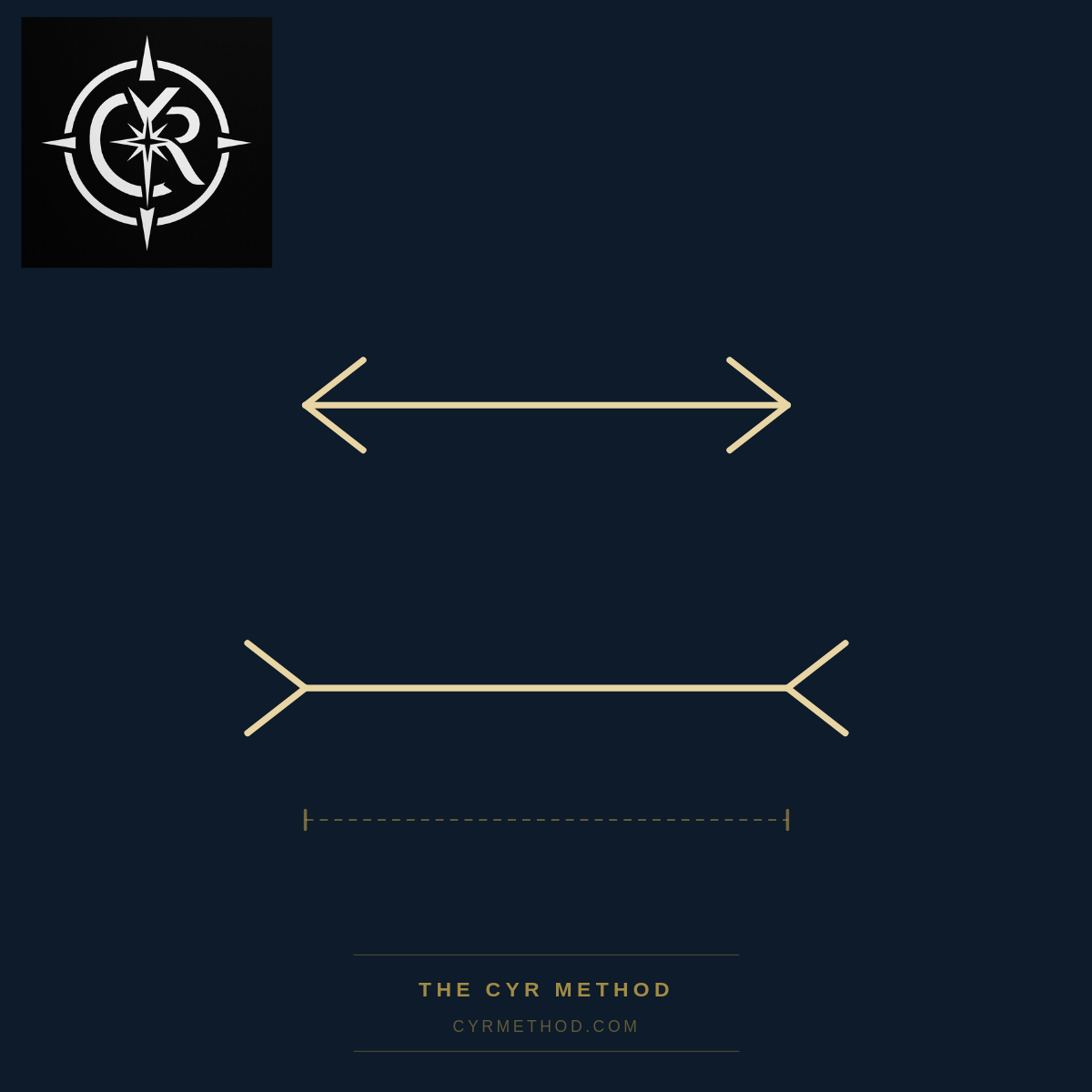
Look at these two lines.
One appears longer. Almost everyone sees it that way.
They are identical.
Müller-Lyer illusion
This is the Müller-Lyer illusion, first documented by Franz Carl Müller-Lyer in 1889 and since studied across cultures and populations. What makes it remarkable is what happens after we know the truth. Even after someone tells you the lines are equal, even after you measure them yourself, you still see one as longer. The knowledge does not fix the perception.
That is worth sitting with. Your brain is actively constructing a version of the world, shaped by pattern recognition, past experience, and predictive shortcuts built up over a lifetime. Most of the time, that system serves us well. It is fast, efficient, and good enough for most of what we need to do.
Good enough and accurate are two different things.
Astrophysicist Neil deGrasse Tyson has made this point in his writing on human perception: our sensory system was built for survival, not for truth. We detect threats, read social cues, and fill in gaps at remarkable speed. Precision was rarely the priority. Staying alive was.
This is simply the architecture we are working with.
The Architecture Gets More Complicated Under Pressure
Understanding that perception is constructed is interesting on its own. What makes it directly relevant to anyone managing a team or navigating a high-stakes conversation is what happens when perception collides with emotion.
Psychologist Marsha Linehan developed Dialectical Behaviour Therapy in the early 1990s as an evidence-based framework for helping people navigate intense emotional states and improve their relationships. One of its foundational concepts describes three states of mind that research suggests most people move between, often without realizing it.
Emotion Mind is the state where feeling takes the lead. Perception triggers interpretation, interpretation triggers emotion, and the emotional response begins to shape everything: what gets said, how it lands, what gets heard, and how long the aftermath lasts.
Reasonable Mind is the state where logic becomes the armour. The emotion is present but it feels unsafe or unprofessional to show it, so it gets buried under facts, positions, and certainty. A person in Reasonable Mind looks composed. They are defended.
Wise Mind is the integration of both. It holds what is felt and what is true at the same time, without either one crowding out the other. Research on DBT suggests this is the state from which most sound decisions, and most durable agreements, actually get made.
Here is the part that matters for communication.
The emotional response starts with the perception of the event, and works outward from there. Which means by the time two people are in a difficult conversation, the chain has already run: perception triggered interpretation, interpretation triggered emotion, emotion pushed each person toward Emotion Mind or Reasonable Mind. And the conversation now happening is several layers removed from what actually occurred.
Both people are acting reasonably from inside their own experience. Both are working from a construction of reality that feels completely accurate to them. Both may be in an emotional state that is shaping what they can hear and how they can respond.
Why This Makes Communication So Hard
This is an argument that the conditions for miscommunication are built into us, and that walking into a high-stakes conversation with an understanding of that changes everything.
Two people. Two differently constructed versions of the same situation. Two emotional states shaped by those constructions. Add history, add power dynamics, add the pressure of a deadline or a budget or a relationship that matters, and the complexity compounds quickly.
Research from Grammarly and Harris Poll found that poor communication costs businesses an average of $12,506 per employee per year. That figure accumulates quietly, through misalignment, through decisions that were only partially agreed upon, through the steady erosion of trust that happens when people keep feeling misunderstood.
Most of it is architecture.
Understanding the Müller-Lyer illusion is useful here precisely because it removes the moral charge. When someone anchors hard to their position in a conversation, the instinct is often to read it as stubbornness or ego. That reading makes the conversation harder before it starts. The person on the receiving end of that assumption feels accused, and people who feel accused defend themselves.
The illusion offers a different frame. Their perception may be as sincere as yours. Their certainty is real, for the same reason your certainty is real. Two people. Same situation. Different constructions. A human problem, with a human solution.
For a closer look at how this plays out with positions versus underlying interests in negotiation, this article on positions vs. interests is worth reading alongside this one.
The Counterweight: Curiosity and Open-Mindedness
If the problem is that we are working with a constructed version of reality, The response that makes the most sense is the same one that drives good science: question your first read. Investigate. Stay open to being wrong.
This is a demanding communication skill, because the brain's default is to treat its own construction as fact and move on. Staying curious requires interrupting that default deliberately.
In negotiation and communication research, the shift from certainty to curiosity consistently produces better outcomes. Fisher and Ury's foundational work on interest-based negotiation is built on this principle: the goal is to understand what is actually true before deciding what to do about it. Control vs. curiosity in negotiation explores the practical difference between those two orientations in more depth.
A few things that support this in practice:
Asking before concluding. One genuine question before a response changes the direction of a conversation. It signals that the other person's version of events is worth understanding, and it creates the conditions for them to offer it.
Updating visibly. When a manager or team lead changes their view based on new information, and does it openly, it trains the people around them that changing your mind is a sign of thinking clearly. The alternative trains people to dig in regardless of what they hear.
Treating the other person's certainty as information. When someone is anchored hard to their position, that certainty is telling you something about what they are seeing, even if they are working with a partial picture. Getting curious about it tends to move things forward. Getting frustrated with it keeps things stuck.
For a deeper look at how this applies in emotionally charged conversations, the difference between empathy, sympathy, and compassion in leadership connects directly to the Wise Mind concept.
This Is Trainable
The people who communicate well under pressure have practiced specific skills, often with deliberate feedback, until those skills are available when the stakes are high and the brain's shortcuts are running fast.
Understanding the architecture is the first step. Knowing that perception is constructed, that emotion compounds the gap, and that certainty on both sides can be sincere and still incomplete, changes how you enter a difficult conversation. It shifts the question from "how do I get them to see what I see" to "what are they seeing that I have yet to understand."
That shift is where most conflict finds its way through.
If your team is losing time and trust to conversations that keep going sideways, the question worth sitting with is this: what would it look like to build these skills deliberately, with practice and feedback, the way you would build any other capability that matters to your results?
If this resonates and you want to build these skills with your team, The Cyr Method offers in-person communication and leadership training for teams in Halifax, Dartmouth, and across Atlantic Canada. Reach out and we can talk about what that looks like for your group.
For more information on training options.
Sources
Müller-Lyer, F.C. (1889). Optische Urtheilstäuschungen. Archiv für Anatomie und Physiologie, Physiologische Abteilung, 263-270.
Segall, M.H., Campbell, D.T., & Herskovits, M.J. (1963). Cultural differences in the perception of geometric illusions. Science, 139(3556), 769-771. https://pubmed.ncbi.nlm.nih.gov/13987678/
Tyson, N.D. (2001). Coming to Our Senses. https://neildegrassetyson.com/essays/2001-03-coming-to-our-senses
Linehan, M.M. (1993). Cognitive-Behavioral Treatment of Borderline Personality Disorder. Guilford Press.
Fisher, R. & Ury, W. (1981). Getting to Yes: Negotiating Agreement Without Giving In. Houghton Mifflin.
Grammarly & Harris Poll (2022). The State of Business Communication. https://www.grammarly.com/business/learn/state-of-business-communication-research/
Illusions Index, Müller-Lyer. https://www.illusionsindex.org/i/mueller-lyer