

The Designed Alliance: A Communication Tool Halifax Managers Can Use This Week
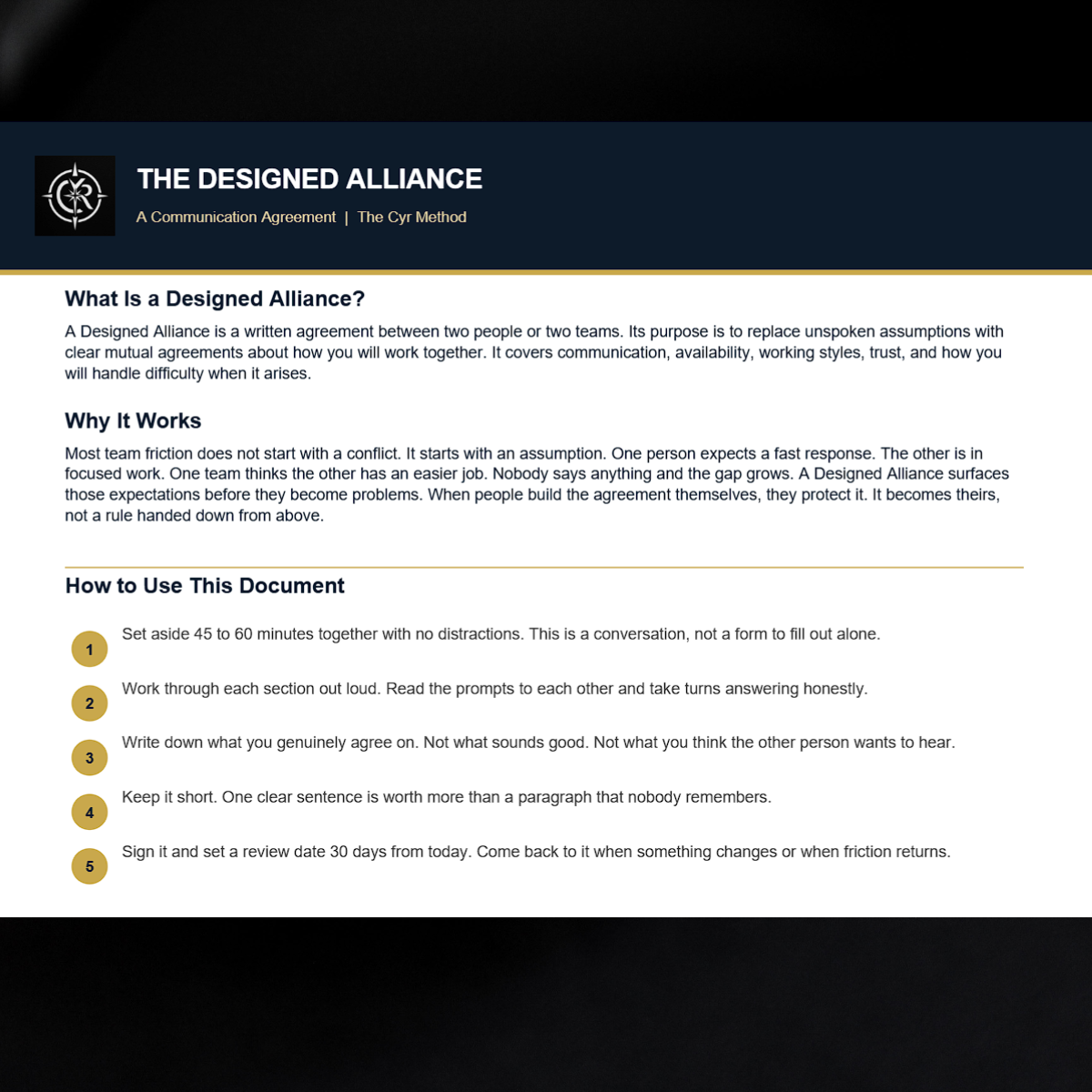
A practical communication agreement for Halifax managers and HR leaders. Free download available further down this page.
The Designed Alliance: A Communication Tool Halifax Managers Can Use This Week
Most team friction has a surprisingly simple root. People assume they know how the people beside them want to work together, and those assumptions are almost never fully right.
The Designed Alliance is a practical tool that replaces assumption with agreement. It is used between two people, or two teams, to make explicit what is usually left unspoken. How do you prefer to communicate? When are you available? What does a productive working relationship look like to you, and what makes it harder?
This article explains what a Designed Alliance is, how it works, and how Halifax managers and HR leaders can build one with their teams starting now.
When the Friction Has a Name, It Becomes Solvable
A few years ago I was working with a company whose project managers were under constant pressure from clients. When they needed answers, they did what felt natural. They reached out directly to individual developers and engineers through back channels, chat, email, text, whatever got a response fastest.
The problem was that those interruptions were landing in the middle of deep focus work. A developer pulled out of a complex problem does not just pause and resume. They lose the thread. The context has to be rebuilt, sometimes taking 15 to 20 minutes each time. Multiply that across a day of back-channel messages and a meaningful portion of productive output disappears. This is the kind of friction that difficult conversations at work are built from, one unspoken assumption at a time.
Resentment built on both sides. The project managers felt ignored. The developers felt constantly disrupted. Neither group was wrong about their own experience. They just had no shared agreement about how to work together.
We sat down with each group separately, then together, and built Designed Alliances between the teams. The alliances outlined which communication channels to use for which situations, when developers and engineers were available for synchronous communication, and what the project managers could realistically promise their clients in terms of update timelines.
The result was immediate. Project managers stopped reaching into back channels because they knew exactly when and how to get what they needed. Developers worked in protected blocks without interruption. And project managers gained something unexpected: the ability to communicate with more confidence to their own clients. "My next check-in with the development team is in two days. I will have more information for you then." That is a sentence built on a real agreement, and clients respect it.
What a Designed Alliance Actually Covers
A Designed Alliance is a short, written agreement. It does not need to be long. The goal is to surface the things that are usually assumed and get them on paper so both sides are working from the same understanding.
A strong Designed Alliance between two people or two teams typically covers four areas.
Communication channels. Which channel is for which purpose. Email for anything that needs a record or a thoughtful response. Chat for quick questions that do not require immediate action. Phone or a direct conversation for anything urgent or emotionally complex. Without this clarity, people default to whatever feels most urgent to them, which is often the channel most disruptive to the other person.
Availability and response expectations. When is each person or team available for synchronous communication, and what is a reasonable response time for each channel. This is where most back-channel frustration originates. One person expects a response within the hour. The other is in focus work for a four-hour block. Neither communicated their expectations. Both end up frustrated.
Working styles. Some people think best in conversation. Others need time to process before they can respond usefully. Some want context before a question. Others want the question first and the context as needed. A few minutes spent surfacing these differences prevents months of friction.
Impact awareness. This is the part most tools miss. The alliance includes a brief section where each side describes what certain behaviors do to their work. A developer explaining that an unscheduled interruption costs them 20 minutes of recovery time is not complaining. They are giving their colleague information that makes it possible to respect their work in a concrete way. The same goes in reverse. A project manager explaining that a missed response affects their client relationship gives the developer a reason to prioritize, not just a request to comply with.
Why This Works Where Policy Fails
Atlassian's Teamwork Lab research found that 74% of executives say lack of communication interferes with the speed and quality of work. Most organizations respond to that finding with a communication policy. A Designed Alliance is different from a policy in one important way.
A policy is handed down. A Designed Alliance is built together. That distinction sits at the heart of moving from positions to interests in any working relationship.
When two people or two teams sit down and build their own agreement, they are not complying with someone else's rules. They are choosing how they want to work together. That distinction matters enormously for ownership. People protect agreements they helped write. They comply with policies until something more urgent comes along.
Research on team cognition published in the Journal of Applied Psychology found that shared mental models, the degree to which team members understand each other's expectations and working styles, explain roughly 19% of the variance in team effectiveness. That connects directly to how team communication shapes productivity at the organizational level. A significant gain available from a conversation that takes less than an hour.
How to Build One
Start with two people or two teams who have regular contact and some existing friction. The friction is actually a useful starting point. It means there is something worth naming.
Set aside 45 to 60 minutes. The conversation has four parts.
First, each side shares their preferred communication channels and why. Keep it practical. What works for you and what makes your work harder.
Second, map out availability. When are you genuinely reachable for a quick question, and when do you need protected time. Put it on paper.
Third, share your working style. How do you process information best. What helps you show up at your best for the people you work with.
Fourth, and most importantly, share the impact. What does it do to your work when communication happens in a way that does not fit how you operate. This is the part that builds empathy rather than just rules, and it is the same skill that makes de-escalation possible when tension does surface.
Once the conversation is done, write it up simply. One page is enough. Review it together after 30 days and adjust what is not working.
Downloadable Template
The Designed Alliance is one of the tools we bring into team communication workshops at The Cyr Method. If you are exploring communication or negotiation training for your Halifax or HRM team, the best first step is a 20-minute conversation.
If this sounds like your team, the Work With Me page explains how we audit what's actually happening, fix what's stalled, and keep it from happening again.
Sources
Atlassian Teamwork Lab. Team Communication Norms Research. 74% of executives say lack of communication interferes with speed and quality of work.
De Church, L.A. & Mesmer-Magnus, J.R. (2010). The cognitive underpinnings of effective teamwork: A meta-analysis.Journal of Applied Psychology.