

Sales Training in Halifax
Sales Training in Halifax: Why Your Team Gives Away Margin and How to Stop It
Two years ago I quoted a client $540 per person hour for our work.
Our normal rate was $240. The project was already in jeopardy. I had spent months rebuilding a broken relationship and doing difficult work that most people in our field would not have touched. My stomach was in my throat when I put the number on the table.
The client looked at it. Then at me. Then back at it.
"When can we start?"
Several months later, that same client laughed and said: "I'm in the wrong business. With what you charge, I should do what you do." They were smiling when they said it. Happy. Because the value had been real and they knew it.
That moment taught me something I have built my practice around ever since. Price is never the real conversation. Value is.
This concept shaped how I approach sales training in Halifax, and what I teach teams who are tired of watching margin walk out the door.
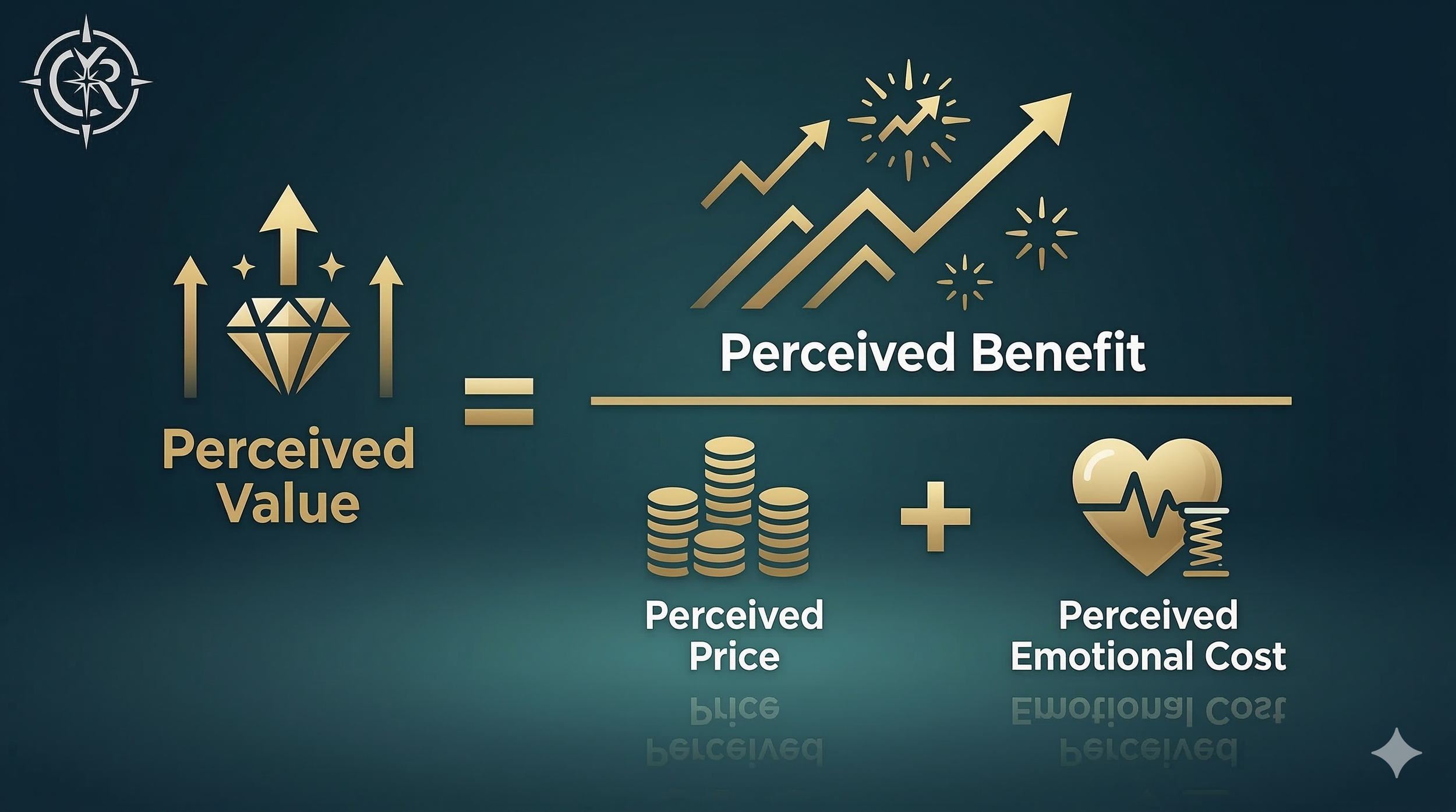
The Perceived Value Formula — The Cyr Method
What Perceived Value Actually Means
Most people think value is about price. It is not. Value is a perception. And that perception is built from three things happening simultaneously in your client's head.
[Image: Perceived Value Formula]
Perceived Benefit is what the client believes they will get from working with you. The outcome. The problem solved. The risk removed. The time saved. The more clearly they can see that benefit, the more valuable you become.
Perceived Price is not just the number on the invoice. It is how that number feels relative to everything else — their budget, their expectations, what they think others charge, and what they have paid before. The same $2,500 can feel expensive or obvious depending entirely on the context you built around it.
Perceived Emotional Cost is the one most people forget entirely. It is the stress, risk, effort, and discomfort a client associates with the decision. Will this work? Will I look bad if it does not? Is this vendor reliable? Am I making a mistake? That emotional weight sits on the cost side of the equation just as heavily as the price does.
Value = Perceived Benefit / (Perceived Price + Perceived Emotional Cost)
When the benefit side of that equation is clear and compelling, a number that would otherwise feel alarming becomes obvious. When it is not clear, even a reasonable price feels like a risk.
This is why two vendors can quote the same price and one gets the job and one does not. It is not always about capability. It is about which one made the value feel undeniable and the emotional cost feel manageable.
Your team is not losing margin because they are charging too much. They are losing it because the value conversation is not getting built before the price conversation begins.
Why Halifax Sales Teams Give Away Margin
For decades, car dealerships solved a problem that most Halifax businesses have not yet cracked.
They noticed that when salespeople controlled their own pricing, margins bled. The salespeople were skilled, motivated, and knew the value of what they were selling. And still, when a customer pushed back, fear took over. Fear of loss. And fear is a terrible negotiator.
So dealerships built a structure around it. Well-run stores gave salespeople a small negotiating range, maybe four percent to work with, enough to feel empowered in the room. Anything beyond that went to the sales manager. Someone whose only job was to protect margins, without the relationship pressure the salesperson was carrying.
That system worked because it accounted for the fear problem structurally:
The salesperson could stay warm
The manager could stay firm
Margins were protected
Most modern businesses cannot run that way. Your project managers are negotiating contract timelines directly with clients. Your property managers are defending management fees in real time. Your hotel sales team is quoting event packages on the spot. There is no gatekeeper. Your people are playing both roles, and most of them were never trained for it.
Here is the good news. They can be.
When a client asks for a discount after weeks of work, something specific happens inside the person handling that conversation.
They do not think: I should protect our margin.
They think: If I push back, I might lose this.
We tend to think of FOMO as a consumer phenomenon. It hits hardest in high-ticket, long sales cycle situations where someone has invested weeks of work and the relationship feels like it is on the line. That fear is the primary driver of unnecessary concessions across every industry.
This is not a new observation. Nobel Prize-winning psychologist Daniel Kahneman and his research partner Amos Tversky demonstrated through decades of study that the pain of a potential loss is psychologically about twice as powerful as the pleasure of an equivalent gain. Their work, known as Prospect Theory, showed that people will take significant risks specifically to avoid loss, even when holding steady would be the more rational choice. That is not weakness. That is human wiring.
It is a fear response. It is completely predictable. And it is trainable.
The traditional answer has been sales training. Scripts, closing techniques, objection handling frameworks. Those tools have their place, but they collapse at exactly the moment they are needed most. When the pressure is real, when the client is pushing hard, when there is actual money on the table, the script goes out the window and the fear takes over.
Picture your team in that moment. The client pushes back on price. Instead of flinching, your project manager gets curious. Your property manager asks a question. Your hotel sales manager stays warm and steady. Margins protected. Relationship intact. That is a trainable outcome.
If your team is based outside HRM or you're thinking about sales training across the province rather than just the city, the Sales Training Nova Scotia piece covers the same principles with a province-wide lens — including the stage of the sales cycle most teams skip entirely
The Negotiation Skill That Protects Margins Without Damaging Relationships
The most reliable tool for protecting a position under pressure is curiosity.
When someone asks for a discount or pushes back on price, the instinct is to cave immediately or get defensive. Both responses come from the same place. The pressure feels like a verdict, and you are reacting to it.
A discount request is information. Often very incomplete information. And one of the most important things to understand is that most pushback is not actually about price — it is about one of three things shifting in the client's head:
The perceived benefit has dropped
The perceived price feels higher than expected
The emotional cost of moving forward has gone up
A curious question tells you which one it is. A concession tells you nothing except that you were willing to move. This is the difference between positions and interests — and understanding it changes everything about how you handle pushback. Read more about positions vs interests here.
Chris Voss, former FBI lead hostage negotiator and author of Never Split the Difference, built his entire framework around this idea. He calls it tactical empathy: the discipline of understanding the other side's position and motivations before responding. His central argument is that the negotiator who listens and stays curious will consistently outperform the one who pushes harder. Curiosity, in his framework, is not softness. It is a competitive tool.
This is where most sales training misses. It treats pushback as an obstacle to overcome. Experienced negotiators treat it as a question to answer.
The shift sounds small. The results are significant.
A Two-Stage Framework for Halifax Managers Handling Pricing Pushback
Here is the practical framework your team can use the next time a client asks for a lower number.
Stage one: Test the ask.
Most discount requests are probes. The client asks because asking costs them nothing. Moving immediately toward a solution signals that the number was negotiable before you even know whether the ask was serious.
Start with questions that are warm and curious. The goal is to understand whether this is a real position or just a probe:
"How did you arrive at that number?"
"What part of what we discussed are you looking to remove to get there?"
"It sounds like you've found another way to solve this?"
In a significant number of cases the client has no real answer. Without a logical foundation, their confidence collapses. The ask disappears on its own. Your team protected the margin without a confrontation, without a concession, and without damaging the relationship.
That is a powerful thing to watch happen.
Stage two: When they hold, go deeper.
If the client has a real answer — a genuine budget constraint, a competing offer, a specific concern about value — now you are in a real negotiation. That is a better position than it sounds, because now you have information to work with.
Go back to the value equation. Which part of it broke down? Ask directly:
"Help me understand what needs to change for this to work on your end."
"What happens for you if we cannot find a way to make this work?"
"What part of the outcome would you be willing to adjust to reach that number?"
These questions surface the real concern, which is almost always more solvable than the surface ask. If the conversation starts to escalate or harden, slowing it down with curiosity is almost always more effective than pushing through. This article on de-escalation in negotiation goes deeper on that.
What This Looks Like for Halifax Teams
Property managers defending management fees: When a building owner pushes back on your fee or questions a maintenance cost, the instinct is to justify or discount immediately. Instead, ask "help me understand what part of this feels out of line with what you were expecting." You will quickly find out whether they have a real concern about the work or whether they are testing whether you will move. Most of the time, they are testing.
Hotel sales managers quoting event packages: When a client says "can you sharpen the pencil on this," ask "what specifically feels out of line with what you were expecting?" If they have a real answer, you are having a real conversation. If they pause and backtrack, the ask disappears and you moved nothing.
Construction project managers pressed on timelines: "What changes on your end if we hold to the original schedule?" Often the urgency a client projects has nothing concrete behind it. Once you ask, you find out. And once you find out, you are equipped.
These are also some of the most common difficult conversations Halifax managers face. The communication skills that help you hold a position on price are the same ones that help you navigate conflict, set expectations, and lead with clarity. If that is landing somewhere real for you, this is worth reading.
Imagine your whole team operating this way. Calm under pressure. Curious before reactive. Protecting margins while keeping the relationship strong. It changes what your company brings home.
Sales training sessions run as a half-day (3 hours) or full day (6 hours), in person, at your location in Halifax or Dartmouth. Groups are capped at 20. Every session is built from a pre-consultation where I learn your team's actual deals, clients, and friction points — so the examples in the room feel familiar because they are. Investment starts at $1,500+tax for a half-day session. No deposit required. Invoice after delivery.
Why Generic Sales Training Does Not Fix This — And What To Look For Instead
Generic sales training teaches people what to say. A script for the objection. A closing technique for the hesitation. A framework that works in the classroom and collapses the moment a real client pushes back with real money on the table.
If you have been searching for sales training in Halifax, you have probably come across franchise-based programs. They are well marketed, globally recognized, and they run the same methodology whether your team sells bridge fabrication in Dartmouth or wedding packages downtown. The frameworks are sound. For someone early in their career who has never been taught any structure at all, they can be useful.
But here is what I hear from teams who have already been through that kind of training.
The scenarios did not feel like theirs. The roleplay was about a generic B2B sale, not about a property manager defending a maintenance invoice or a hotel sales manager explaining why the food and beverage minimum exists. When the examples feel abstract, the skills stay abstract.
The methodology was rigid. A universal system gives you a script for every situation. But when a long-standing client calls and says they need a better number or they are walking, the framework you memorized is not what fires. Your instinct is. And if your instinct was never trained against your actual pressure points, the system collapses at the moment it matters most.
The training stopped when the session ended. A two-day program with no pre-consultation and no connection to the real deals your team is working means the learning peaks on day two and fades by week three.
This is not a criticism of any specific program. It is a structural reality of any training model built to deliver the same thing to every team in every industry in every city.
One of the most expensive patterns I see in Halifax teams is what I call buying a deal — giving away margin just to close, because the discomfort of holding firm feels worse than the cost of the concession. That pattern does not get fixed by better scripts. It gets fixed by changing the instinct that fires when someone pushes back on price.
The car dealership solved the margin problem by building a structure around fear. Your team can build that structure inside themselves. That is what this kind of training develops — not a methodology to memorize, but a set of instincts trained against the conversations your team actually has.
What I do differently is simple. Before I build anything, I learn your business. I talk to you about the deals your team is losing margin on, the conversations they are avoiding, and the patterns that keep repeating. The workshop that lands in your room is built from what I find. Your team practices on scenarios they recognize because the scenarios came from their work. The pushback they rehearse sounds like the pushback they actually hear.
These are all learnable skills:
The curiosity to ask before reacting. The discipline to let the client explain themselves. The habit of building value before presenting price.
When your whole team has these tools, the difference in what you protect on bids, contracts, event packages, and project timelines compounds fast. Quarter after quarter.
The numbers back this up. Research consistently shows that organizations investing in negotiation and communication training see measurable margin improvement, with some reporting an average return of $54 for every dollar invested in negotiation training programs. That kind of return does not come from better scripts. It comes from building the instinct to stay curious, protect margin, and hold a position in the specific conversations your team faces every week.
If you have been through a program before and it did not change what your team actually does on a call or in a meeting, that is not a reflection of your team. It is a reflection of the training.
My client did not laugh about my rate because I got lucky. They laughed because by the time the invoice arrived, the value was so obvious the number looked small. That is the goal. For you, and for your team.
Your team is capable of this. They just need the tools.
If this sounds like your team, the Work With Me page explains how we audit what's actually happening, fix what's stalled, and keep it from happening again.
Frequently Asked Questions (FAQ)
How long is a sales training workshop?
Most teams start with a half-day session — three hours with a break, which is enough time to teach a core framework, run practice scenarios, and debrief. Full-day sessions go deeper and can cover multiple modules. Sessions can also be split across two or three shorter blocks if your team cannot be pulled away for a full afternoon. Lunch-and-learn formats work well for teams that want to keep disruption low.
Can you train my team at our office?
Yes. I deliver in person at your location anywhere in Halifax, Dartmouth, or HRM at no additional travel cost. I can also travel to other parts of Nova Scotia or Atlantic Canada — travel costs apply outside HRM. If your team is spread across locations, remote delivery is available, though in-person consistently produces stronger results.
How many people can attend a session?
Groups are capped at 20. Below that number, everyone gets to participate, practice, and ask questions. Above 20, the quality drops — it becomes a seminar instead of a workshop. If your team is larger than 20, we can run multiple sessions.
What is the difference between sales training and negotiation training?
Sales training typically focuses on the selling process — prospecting, discovery, presenting, closing. Negotiation training focuses on what happens when the other side pushes back — on price, on terms, on timelines — and how to hold your position without damaging the relationship. Most teams need both, and in practice the line between them blurs. My sessions sit at that intersection: building the value conversation so your team stops giving away margin when the pressure shows up.
Do you offer ongoing training or just one-off sessions?
Both. Most clients start with a single session to see whether the approach fits their team. From there, some book a second session to go deeper or cover a different module. I also offer retainer arrangements for teams that want ongoing development — but I will not suggest a retainer until we have done at least one session and you have seen the results for yourself.
What industries do you work with?
I have trained teams in construction, property management, hospitality, healthcare, public safety, and technology. The communication and negotiation skills are transferable across all of them. What changes is the context — and that is why every session starts with a pre-consultation. The examples your team practices on come from their world, not a textbook.
Sources
Kahneman, D. and Tversky, A. (1979). Prospect Theory: An Analysis of Decision under Risk. The foundational research behind loss aversion, published in Econometrica. Kahneman was awarded the Nobel Prize in Economics in 2002 for this body of work. The research established that the psychological pain of a potential loss is approximately twice as powerful as the pleasure of an equivalent gain. Link: web.mit.edu/curhan/www/docs/Articles/15341_Readings/Behavioral_Decision_Theory/Kahneman_Tversky_1979_Prospect_theory.pdf
Columbia University Mailman School of Public Health (2020). Global Study Confirms Influential Theory Behind Loss Aversion. A replication study conducted across 19 countries and 13 languages confirmed the original findings of Prospect Theory, with a 90 percent replication rate. Published in Nature Human Behaviour. Link: publichealth.columbia.edu/news/global-study-confirms-influential-theory-behind-loss-aversion
Voss, C. and Raz, T. (2016). Never Split the Difference: Negotiating As If Your Life Depended On It. The definitive practical framework for high-stakes negotiation, developed by former FBI lead hostage negotiator Chris Voss. The book introduces tactical empathy and calibrated questioning as the core tools for staying curious and in control under pressure. Link: blackswanltd.com/never-split-the-difference
RED BEAR Negotiation Company. Measuring the ROI of Negotiation Training. Research and documented case studies on the financial return of negotiation training across industries, including a Fortune 1000 company that saw a 46.7 to 1 return on investment after implementing structured negotiation training. Link: redbearnegotiation.com/blog/roi-negotiation-training